 Nepal Newsbox
2083 Jestha 16, Saturday
Nepal Newsbox
Nepal Newsbox
2083 Jestha 16, Saturday
Nepal Newsbox
Nepal’s Youths are Blocked


Nepal’s Youths are Blocked
Why Nepal’s Youth Can’t Move Forward — and How to Unblock Them”
By Rameshwar Yadav
Nepal’s youth are not lazy, unskilled, or unmotivated. They are simply blocked — blocked by a system that neither guides them nor trusts them.
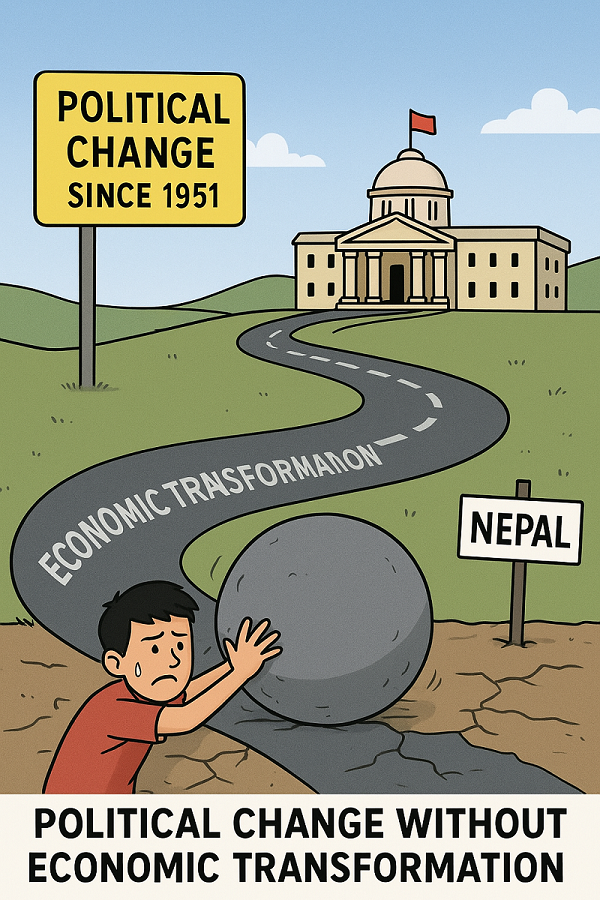
Nepal’s youth are not lazy, unskilled, or unmotivated. They are simply blocked — blocked by a system that neither guides them nor trusts them. After years of education and training, thousands of young people find themselves stranded in the very country that once told them to dream big. The government has closed both its eyes and mind to youth empowerment. What we are witnessing today is not a generation without potential, but a nation without a support system.
The story of Nepal’s youth is not about failure — it is about frustration. Young graduates return home with certificates that open no doors. Skilled trainees, trained under government or private programs, find no pathway to employment or entrepreneurship. The enthusiasm that once defined the young Nepali spirit is slowly turning into exhaustion. The tragedy is not that our youth are leaving for foreign employment — it’s that they feel they have no choice but to leave.
1. The System That Punishes Initiative
“In Nepal, starting something new feels like breaking a law, not building a dream.”
After completing higher education or vocational training, youth expect a bridge — some form of mentorship, startup support, or government incubation — that helps them cross from learning to earning. Instead, there is a wall. Every department that should encourage entrepreneurship or innovation often becomes a source of frustration.
The Office of Company Registrar, the Inland Revenue Department, and even local ward offices operate like bureaucratic traps, not service providers. Young entrepreneurs, who should be celebrating their first venture, find themselves drowning in paperwork, technical jargon, and inconsistent rules. Many give up before even starting because the process feels designed to discourage rather than help.
Instead of simplifying processes, these offices make youth run from counter to counter, demanding documents and signatures that could easily be digitized or centralized. For a country that speaks of “Digital Nepal,” the irony is painful — our systems remain manually paralyzed.
It is absurd that a single private company must register in three separate offices — the ward office, Office of Company Registrar, and Inland Revenue Office — just to start legally. For a young entrepreneur with limited funds and no legal training, this system feels like a punishment for daring to dream. What should have been a week-long procedure turns into months of confusion and expense.
2. Financial Barriers: Banks that Don’t Believe in Youth
“The banking system measures potential in square feet, not in creativity.”
Banks are supposed to be partners in progress, but in Nepal, they are gatekeepers of privilege. Most young entrepreneurs are turned away because they don’t have collateral. The message is clear: unless your family already owns property, your idea doesn’t matter.
The banking system measures potential in square feet, not in creativity. As a result, banks fund those who already have wealth, not those who are trying to create it. The energy, imagination, and hunger of youth remain untapped, while those with land and legacy enjoy easy access to credit.
This makes small startups nearly impossible for ordinary young people. Many are left with no option but to either work abroad or abandon their dreams altogether. Instead of being an engine of opportunity, the financial sector has become a fortress — protecting the old and blocking the new.
What Nepal needs is not more banks, but more belief — belief that innovation and honesty can be collateral too.
3. Political Capture of Opportunities
“Merit is invisible when politics owns every opportunity.”
In today’s Nepal, opportunity is often defined not by merit but by membership. Politicians and their party networks have occupied every corner of opportunity — from government contracts to grants, fellowships, and even appointments in public institutions.
Ordinary youth, especially those without party affiliation, are pushed to the margins. The few who try to rise independently face invisible barriers — favoritism, nepotism, and the quiet whisper of “party connection.” This political capture has created a generation that feels invisible in its own country.
The result? A silent brain drain — not only of skills but of faith. When politics replaces performance and connection replaces competence, a country’s foundation starts to rot from within.
4. Lack of Freelancing and Startup Ecosystem
Globally, freelancing has become a new engine of youth employment. Countries like India, the Philippines, and Bangladesh are earning billions of dollars annually through their freelancers. Yet in Nepal, the concept is hardly recognized or supported.
There are no government-led digital freelancing platforms, training programs, or policy frameworks to encourage independent work. Instead, even small freelance earners are forced to register companies and face the same bureaucracy as large firms.
This outdated system discourages creative, tech-savvy youth who could be earning and learning through global online platforms. A young graphic designer or coder shouldn’t need to navigate tax laws or register a private company just to earn from Fiverr or Upwork.
Nepal is sitting on a goldmine of digital talent, but it has neither the tools nor the trust to mine it.
5. Key Reforms: How to Unblock the Generation (Practical and Doable Solutions)
Nepal doesn’t need another political speech on youth empowerment — it needs simple, structural reforms that unblock young people’s path to progress. The following actions are both realistic and achievable if implemented with willpower and accountability:
a. Single-Window Youth Business Portal
Create a digital “one-door” system for all startup and company registration needs — from local ward approval to PAN registration. This would save time, eliminate middlemen, and reduce corruption. Imagine if a youth could register their business, get tax ID, and receive mentorship within a week — all online. That’s not a dream; it’s a policy choice.
b. Youth Startup Fund without Collateral
Establish a government-backed Youth Startup Fund with soft loans and mentorship instead of collateral. Partner with banks to launch idea-based financing, where innovation and skill are trusted as much as property papers. If other countries can fund ideas, why can’t we?
c. Freelance Recognition and Support Program
Recognize freelancing as a formal employment category. Provide free digital skills training, promote online payment systems like Payoneer or Remitly, and protect freelancers from unnecessary taxation until they reach a sustainable income level. A little freedom for freelancers can create a large ripple in national productivity.
d. Local-Level Entrepreneurship Hubs
Each municipality should have a Youth Innovation Desk — a small but powerful unit that guides, counsels, and helps register startups. Trained officers can help youth navigate legal and tax issues, avoiding dependence on exploitative middlemen. These hubs can become the first real bridge between government and young citizens.
e. Simplified Legal Framework
Unify all company registration under one integrated digital system. Remove the need for multiple registrations and establish automatic data sharing between government departments. The fewer the doors, the more the youth can walk through them.
f. Mentorship and Internship Networks
Link experienced entrepreneurs and professionals with young innovators. Real mentorship can often do more than financial help — it builds confidence, direction, and clarity. A monthly mentorship program led by successful Nepali entrepreneurs could guide hundreds of startups toward success.
6. A Call to Responsibility
“Every plane ticket out of Nepal represents another dream blocked at home.”
If Nepal continues to ignore its youth, the nation will lose not just talent but also hope. Every plane ticket out of the country represents another dream blocked at home. Every remittance dollar is a reminder that a dreamer had to go elsewhere to make it real.
Youth do not need charity — they need access, trust, and opportunity. They need a system that says “Yes, we believe in you,” not one that asks, “Where is your collateral?”
A system that supports its youth doesn’t just create jobs; it creates a future. It builds a nation where innovation, not intimidation, defines success. It’s time to unblock Nepal’s generation — not with slogans, but with systems that work, doors that open, and leaders who listen.
Related News