 Nepal Newsbox
2083 Jestha 16, Saturday
Nepal Newsbox
Nepal Newsbox
2083 Jestha 16, Saturday
Nepal Newsbox
These Days, the Minister Sounds Unhinged (A Story of Dr. Rajendra Bimal)

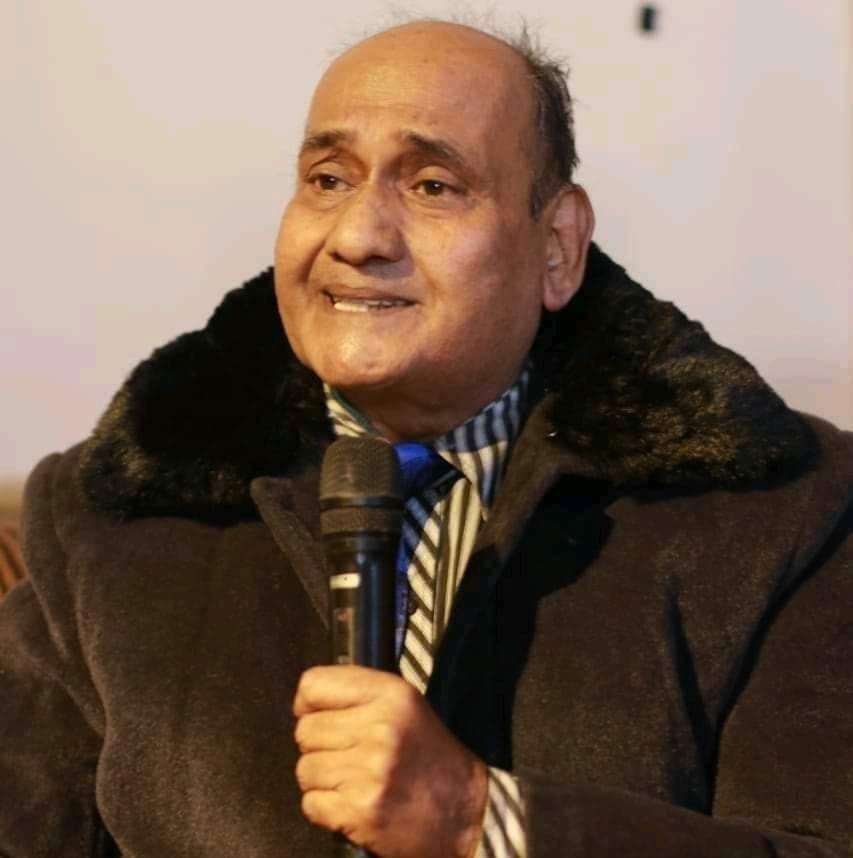
These Days, the Minister Sounds Unhinged
By Rajendra Bimal
Translated By: Rameshwar Yadav
“Umm–mwah!”
“Umm–mwah!”
“Umm–mwah!!”
“A…pa…r…na… I love you.”
The sound echoed everywhere—down into the underworld, across the earth, and up into the sky.
“A…pa…r…na… I love you!!”
Minister Nandan Shah pressed his palms together and planted three warm, smacking kisses on the eight fingers between them. Then, cupping the kisses in his hands, he blew them toward his imagined beloved, sending them fluttering through the air like rose petals scattered by the wind.
After that, he cried out, his voice rising—
“Aparna!”
“Aparna!!”
“Aparna!!!”
The minister isn’t entirely mad—just mad enough to make you wonder. Halfway there. Some days his mind has full signal; other days it drops into a dead zone. And when the signal fails, he explodes. He shouts at his wife, his children, even the servants, scolding them without end.
Their cries, drenched in helplessness, passed all the way to my small hut. Then the throwing begins. One by one, he hurls things into the street—pots, the television, the computer—until the house seems to empty itself of sense.
On days when his mind is only slightly less erratic, he steps out onto the balcony of his three-story house and begins to deliver speeches. To him, the street below is his Parliament, and the people who happen to be standing there are his MPs. The subjects he chooses are baffling.
Today, for example, he spoke on the role of sexuality in political upheavals—from the birth of politics to the present day. His conclusion was delivered with solemn certainty: if great figures like Gandhi or Mahara had such an intimate relationship with sex, then to criminalize it—to deny societies the contributions of great men and leaders on that basis—is not just immoral, but a historical crime.
At the end of his speech, he leaned over the balcony and addressed the street below.
“Is it really a crime,” he asked the crowd of the street, “if someone enjoys alcohol and sex without harming anyone? Or is it just envy—the envy of those who never tasted the pleasures others have?”
Then Minister Nandan Shah—Nandu to those who knew him—added with a dismissive wave of his hand, “Friends, Forget education. Join a political party. Make the leader of a powerful faction your spiritual father, and you’ll rule. Do otherwise, and your life will be worse than a dog’s.”
The crowd applauded.
A moment later, the minister retreated to his room, though not without resistance. His wife had to step in, grip his arm, and pull him back inside before the storm in his head could fully settle.
Nandu Teli is not just my neighbor; he is my old classmate. We once grazed buffaloes together in the chauri. I can still hear the song he used to sing, stretched out on a buffalo’s back as it chewed lazily—“Helal, helal, mahisiya paanime…”
As children, Nandu would oil and massage the teachers’ feet and backs, call the village elders kaka or dada with practiced politeness, and scramble up the tall jamun trees to feast on their dark fruit, proudly sticking out his black-and-blue tongue afterward. He spent whole days swimming in the village ponds, returning home each evening with fever-red eyes and earning a sharp scolding from his father, Hare Ram Teli.
Who could have imagined that this same Nandu would one day become a minister?
Generally, Nandu was loved by everyone—a boy so harmless he wouldn’t cause trouble. But at school, he never quite managed to avoid a beating.
At the heart of the village stood a large neem tree. Beneath it, an Indian teacher would hold class for the smaller children, a stick always in his hand, chanting, “Two ones are two, two twos are four…” We went there too, carrying our sacks to sit, wooden slates, and pieces of chalk. The teacher had bulging eyes, which earned him a village nickname: Buldyangra Guruji.
One afternoon, as he lowered himself onto a chair, one of its legs gave way. Buldyangra Guruji crashed to the ground, his dhoti flying up. His rage—and the terror it inspired—froze us where we stood. No one dared laugh out loud. We pressed our hands to our mouths, shoulders shaking as we swallowed our giggles.
Nandu couldn’t. He burst into applause and shouted, “It’s revealed! It’s shown! Guruji’s secret part!”
That was the day the innocent, straightforward Nandu Teli was beaten thoroughly.
Not far from the neem tree stood a jujube tree. A bearded Maulvi used to bring his goats there to graze. One afternoon, his skullcap perched neatly on his head, a beedi smoldering between his fingers, he watched over the herd through drifting curls of smoke.
The sight of the goats stirred something sudden in Nandu. Without thinking, he shouted out, “Allah… Allah… le le Allah…”
What no one accounted for was Nandu’s speech—when he tried to say ra, it always came out as la. To the Maulvi’s ears, it sounded like mockery: Allah… Allah… le le… Allah…
The Maulvi bristled. Is this boy ridiculing me? he thought. In a flash, he sprang up, stormed over, and seized Nandu by the arm. Four sharp slaps followed—so fiercely that the ember of the beedi nearly flared to life.
Poor Nandu had no idea what he had done. He folded his hands in greeting, ducked his head, and ran home. He didn’t even cry—just kept rubbing his burning cheeks, trying to understand the punishment.
Up to the fifth grade, Nandu was always the top student in his class. People said it was only because his father, Hare Ram Teli, happened to be the school secretary—that favoritism, not talent, kept him in first place.
But when Nandu passed out of the village school, Ramrati Devi and enrolled at Sunshine Secondary School, his shine faded. There, he proved to be no more than an average student. His circle shifted too. He began keeping company with rebellious boys like Kaushal, Ramchandra, and Bauye Lal. It was with them that he learned to climb jamun trees and spent entire afternoons swimming in the ponds.
Whenever anyone asked him, “What will you become, boy?” Nandu would answer with proud certainty, “Chaintis”—his crooked pronunciation of scientist.
Dr. Hare Ram Teli’s chest once measured a full fifty-six inches, swollen with pride. These days, it is slowly shrinking.
Kaushal had been stuck in the ninth grade for four years. Always failing, yet somehow, he was the hero of his classmates. He played cricket with skill, sang beautifully, and could charm anyone on the mouth organ. He could dance, too, and he held sway as a member of the student union—able to call a school strike whenever he pleased. Ramchandra and Bauye Lal followed his every command, even helping him get school fees waived. Some girls couldn’t resist being near him.
Kaushal was clever, audacious, and daring. He would light a beedi, puff it, and blow smoke out of his nose. He handled ganja and bhang effortlessly. He could drink alcohol straight from a bottle without flinching.
One day, a girl named Savitri dared him to climb a tall tree and bring down a ripe, golden mango. The tree towered over the schoolyard, but Kaushal didn’t hesitate. He scrambled up, branch by branch, until he reached the top. Below, a crowd of fifty students watched, enthralled. On a thin, wobbly branch, Kaushal danced and clapped, a showman in his element. Cheers erupted from the students beneath him.
Then misfortune struck.
In an instant, Kaushal and the branch beneath him crashed to the ground. Bones cracked loudly in his arm, leg, and back—seven places in total. He spent three grueling months in the hospital, plastered up and groaning in pain. And yet, even there, when the most admired girls from school came to visit, touched him, and comforted him, he felt a strange, intoxicating mix of pride and bliss—proof that, even in suffering, his legend endured.
By the age of twelve, Nandu was captivated by Kaushal, the charismatic troublemaker whose energy seemed to pull everyone in. Soon, Nandu found himself attending student union meetings, his studies falling behind. The dream of becoming a scientist faded, replaced by a new, fervent ambition—to bring democracy to his country.
By ninth grade, he was failing nearly every subject. Yet his father, Dr. Hara Ram Teli, remained a man of influence and standing, shielding him from the worst consequences.
That same year, under the leadership of the Iron Man Ganeshman Singh, Nepal’s democratic movement surged forward. Students from Saptari were led by Ranbir Singh of Kanchanpur, and Nandu became one of them. He carried the Nepali Congress flag at the head of student rallies, marching with a fire in his eyes. Leading groups of peers, he hurled stones at the police, forced shop shutters to close, set small vehicles ablaze, and engaged in acts of vandalism.
Ranbir Singh provided the students with everything—food, drugs, even weapons. Spears and lances were handed out, revolutionary speeches blared, and Nandu was pushed to throw himself fully into the struggle. Under Ranbir’s guidance, Nandu took drugs in precise doses, making him feel like a hundred lions at once. He shouted and roared, ready to confront the king’s army.
Wherever they met police or soldiers, Nandu would draw the Nepali Congress flag from his waist, wave it high, and chant:
“Long live the Nepali Congress! Down with King Birendra!”
Ranbir Singh’s daughter was Aparna. She was older than Nandu—beautiful, lively, and already in her first year at Ramnagar Agricultural College. Nandu’s attraction to her only deepened his fever for the revolution. The truth was simple: he wanted to prove his courage, to dazzle Aparna with his bravery in the streets.
Aparna, for her part, seemed to notice him. She would throw her arms around him, kiss him again and again, and say openly, “Nandu is the loveliest chap in the world.”
Each time he heard those words, it was as if four bottles of Black Horse liquor rushed through his veins at once. He lost all control—wild, reckless, charging ahead like a mad elephant.
Aparna’s father, Ranbir Singh, divided the revolutionary students into groups. He assigned each one its task for the demonstrations—names, locations, leaders—everything neatly planned. Each group had a leader called a Captain, whose initials were written boldly at the top of the list.
Nandu Teli found himself placed in the S Group. At the top of his list was written: Captain N.T.
For a moment, his chest swelled. Then he learned the truth—N.T. did not stand for Nandu Teli. It belonged to Narmadeshwar Thapa.
Each student was handed a tin whistle, a party flag, and a copy of the group list. Nandu’s group was assigned to march along the main road, carrying torches. They had barely gone two hundred yards when an armored vehicle screeched to a halt. Soldiers leapt out and began beating boys and girls alike, without warning or mercy.
Panic scattered the procession. Almost everyone managed to run.
But the great revolutionary Nandu Teli—the same Nandu whom Aparna had sent off with a victory mark on his forehead—stood frozen. He had never learned how to run.
They searched Nandu and found a four-star flag tucked beneath his waistband. Along with it came the group list—Captain N.T. written boldly at the top. The army commander drew his own conclusion. Captain N.T. must mean Captain Nandu Teli.
What followed was merciless. The soldiers beat him until his body became a pulpy, blood-soaked mass. Then they flung him into a vehicle like a corpse, while booted, beastlike soldiers stood over his small, broken body with cold satisfaction.
Seven days later, taking his age into account, they released him.
When Nandu tried to move his head, it rattled like shards of glass shaking inside a jar. Dr. Hare Ram Teli wept without pause. His wife, Rekha Devi, fainted again and again.
But Nandu felt nothing of it.
As soon as he was freed from the army camp, Aparna came to see him. She kissed him all over, and he felt life surge back into his battered body. Revived, intoxicated, he returned to the movement.
Soon after, Dr. Hare Ram and Rekha Devi heard the news crackle through the radio: Nandu had been arrested again. This time, the police had dragged him away. He had not eaten for seven days.
Rumors spread quickly. Some said the army had beaten him to death with rifle barrels, blood splattering everywhere. Others whispered that only his head had been found—deep in the jungles of Charikot.
Hearing one rumor after another, Dr. Hare Ram slowly lost his bearings. He could neither eat nor sleep. At the sound of footsteps, he would rush outside, hoping—every time—that it was his son.
One day, someone told him the army had buried seven revolutionaries in a pit near Kamala. That very day, Dr. Hare Ram suffered a heart attack.
Blood began to stream from his wife’s nostrils. She nearly collapsed into a brain hemorrhage.
When multiparty democracy was finally declared, the political prisoners—long confined to windows of darkness—were able to breathe the open air of freedom once again. In Saptari, a grand celebration was organized to welcome Nandu Teli home. Garlands were draped around his neck, and a procession wound through the streets in his honor.
But his father did not return with him. And his mother’s condition remained fragile, uncertain, and grave.
Whenever the party held a national program in Saptari, senior leaders—Girija Babu, Kishun Ji, Ganeshman Singh—would arrive in convoys. In public, they placed their hands on Nandu’s shoulders, patted his back, and praised him before the crowds. Ranbir Singh and Aparna followed him everywhere, like shadows tied to his feet. People whispered with certainty that, in the coming parliamentary elections, Nandu would be given a Congress ticket.
But when the distribution of tickets began, the true face of the so-called democratic parties slowly revealed itself—bound in the iron chains of caste, communalism, nepotism, patronage, and internal factionalism. Nandu received nothing. No post. No place. His patience frayed, then snapped.
Disillusioned once more, he watched as the Madhes region was again set ablaze by yet another “revolution.” Demands for rights rose from every corner, and alongside them grew a culture of national decay: a country where abusing the hill people could cost you a ministership, but abusing the Madhesi people could one day make you prime minister. Nandu, too, joined the frenzy. He hurled stones at the houses of hill people and shouted curses into the streets.
During one protest, the so-called Madhesi leader—Honorable President of the Free Madhes Party, Sukhilal Yadav—was struck on the head by a police baton. He collapsed, his skull fractured, and was taken to the Neuro Hospital in Biratnagar, where he remained for twenty-one days. Throughout those days, Nandu served him like Hanuman serving Lord Ram—perhaps with a devotion greater than Hanuman’s entire lifetime. He even sold his family’s farmland and donated one million rupees to the party.
The sacrifice was not forgotten.
After the Barahbunde (Twelve-Point) Agreement, when a coalition government was finally formed, Nandu Teli found his political redemption. He was sworn in as the Minister of Food and Agriculture.
On the day he took his oath as a minister, Nandu remembered another oath he had once taken in the streets. During the movement, he had snatched a rifle from a policeman, rushed to the town square, and fired one hundred and one rounds into the air. Even then, perhaps, a shadow of doubt had crossed his mind. He had never imagined that life would turn this way—that convoys of polished cars would race past him, that soldiers would salute him every morning, or that crowds would shove and elbow one another just to catch a glimpse of his face.
His feet no longer touched the ground. He could now speak for hours without notes, dissect politics on television with effortless confidence, and be hailed everywhere as a hero. Minister Nandu Teli launched raids across the country—on food warehouses, luxury hotels, and sweet shops. He enforced anti-adulteration laws with ruthless efficiency; those caught went straight to jail. Black marketeers began leaving sacks of money at his doorstep.
For the first time in Nepal’s history, he introduced agricultural insurance. Farmers celebrated him like a savior.
At the inaugural meeting of the Farmers and Agricultural Research Center, Nandu was startled to see Aparna seated as a director. Their old bond, once forged in slogans and street marches, deepened into something more dangerous. Aparna’s husband, Rajkamal Khadka, was a lawyer in the appellate court—a man whose physical inadequacy had left Aparna longing for motherhood and emotional fulfillment. Now, her femininity seemed to awaken with new hope. The rise of juniors under the Maoist government had also stirred a quiet resentment in her; she wanted promotion, status, power. Becoming a joint secretary was now within reach.
In broad daylight, under the pretext of official meetings, Aparna visited Nandu’s ministry. Behind closed doors, meetings turned into intimacies. Drawn increasingly toward her, Nandu surrendered to the thrill.
At Aparna’s suggestion, another woman was drawn into his orbit—a young woman named Rita. Rita’s father and Aparna’s husband were colleagues in the appellate court. A silent agreement was reached: Rita would be granted an official position in the ministry, and in return, she would spend two days every month with Nandu—at Nagarkot or Chandragiri. The excuse was always “ministerial work.” Though Nandu shared everything with Rita, his emotional loyalty remained with Aparna.
Once, he took Rita to Hong Kong for an international agricultural conference. Something happened there—something that cracked the fragile balance of secrets. A violent domestic argument followed, pushing events toward a point of no return.
After their return, Rita was found hanging from a sal tree in the Guheshwori forest. The day before, she had visited Pashupatinath.
Accusations erupted from all directions. Nearly ninety percent of the party’s central committee belonged to the Yadav community, and they saw this Teli minister as an obstacle. Under mounting pressure, Party President Sukhilal Yadav expelled Nandu from the party. A letter arrived ordering him to vacate his ministerial residence.
When Nandu turned to Aparna for shelter, her husband, Rajkamal Khadka, refused to let him stay—even for two days.
As if his disgrace were not enough, another shadow rose to swallow Nandu whole. A new case surfaced, and the media erupted with lurid headlines. During the Indian border blockade, a Deputy Superintendent of Police had been brutally murdered—and the finger now pointed squarely at former minister Nandu Teli.
According to the reports, Nandu had exploited the blockade to run a petrol-smuggling network. When DSP Rajeev Kandel and his team intercepted a truck loaded with petrol cylinders for inspection, the confrontation turned fatal. It was alleged that Nandu, aided by hired criminals from the Madhes Liberation Party, had orchestrated Kandel’s murder on the spot.
The story spread like wildfire, repeated endlessly on television screens and front pages. Public outrage swelled. The trial moved swiftly, almost mercilessly. In the Special Court, the verdict came down heavy and final: Nandu Teli was found guilty of the murder of DSP Rajeev Kandel.
He was sentenced to life imprisonment.
The final blow came from Ladu Sah, a powerful trader in pepper and Sukumel, who filed a formal complaint with the Commission for the Abuse of Authority. Along with the complaint, he submitted meticulous evidence of corruption—documents that left little room for denial.
The charges were proven. The judgment was ruthless in its precision.
Nandu was sentenced to five years in prison, fined 40 crore, 55 lakh, 95 thousand, 990 rupees, and ordered to surrender property worth an equal amount. The Department of Money Laundering Investigation revealed that he had illegally amassed close to 88 crore rupees during his rise to power.
Under Section 10, Subsection 1 of the Corruption Prevention Act of 2002, Nandu was convicted of grave criminal offenses. Newspapers no longer called him a former minister or a revolutionary hero. He was now compared to the fearsome villains of Hindi cinema—the infamous dadas, men whose power thrived on intimidation, excess, and impunity.
Thus ended the public life of Nandu Teli: once a flag-bearer of revolution, now a cautionary tale etched into court records and headlines.
Nandu was sent to prison. The sweet dreams once harbored by his teachers—who had imagined him becoming a scientist—slowly withered as he decayed behind bars. His mother died in silence; only ten relatives stood by her funeral pyre, counting the ashes where a family’s hopes had burned away.
Twelve years later, when Nandu stepped out of prison, respect did not follow him home. Society greeted him with a cold, deliberate indifference. Stung by the sudden humiliation, he muttered through clenched teeth, “Sugar-coated flies… all of them.” He ranted endlessly, yet refused to admit that something inside him had fractured.
In his mind, his home had turned into a parliament, and his wife, son, daughter-in-law—even his own blood—were nothing but the opposition. The debates were no longer verbal. Chairs flew across rooms. He hurled them at his aging wife, his terrified daughter-in-law, even toward his small grandson. His voice rose like a collapsing roof.
“I will not let this house run like parliament!”
And the house fell into chaos.
From the wreckage of broken furniture and shaken silence, his slogans erupted once more—hollow, mechanical, and wild:
“Inquilab Zindabad! End corruption! Control inflation!”
That morning, his madness crested.
From the edge of his five-story balcony, Nandu clenched his fist as if gripping an invisible microphone and launched into a speech no one had invited him to hear.
“Alcohol and sex should be free,” he roared. “The right to enjoy life is fundamental! Your father has no authority over you. Inside a closed room, you should be free to do anything you want!”
His voice ricocheted across the street.
“Who here is innocent?” he shouted. “Let there be an investigation! Curse it—why is small corruption condemned while big corruption is excused? Is it envy? Is that it?”
He laughed, a harsh, broken sound.
“This country runs on one rule,” he went on. “Those who never got a chance to steal shout the loudest. The moment they get the chance, they plunge in headfirst.”
He leaned over the railing, eyes blazing.
“Money—just money. That’s the system. Earn it any way you can. Money buys power. Money buys position, prestige, education. If you have money, the world kneels before you.”
He paused, breathing hard.
“And if you don’t?” he snarled. “Your life is worth less than a slave’s.”
Teela, his rheumatic wife, hurried onto the balcony and grabbed him, trying to drag him back inside. But the speech refused to die.
“Every political system has turned into a playground for thieves,” he ranted. “No republic—no end to corruption. No democracy—no justice!”
Teela tugged at his arm with what little strength her aching joints allowed, but Nandu wrenched himself free and roared even louder.
“Strip democracy of corruption and glitter,” he screamed, “and if anyone still lines up to contest an election—then I’m a dog!”
He beat his chest, foam at the corners of his mouth.
“I’m a dog!” he howled. “And you—” he flung a finger at the street below, “—you’re all bitches!”
The balcony trembled with his voice, and the house behind him shrank into silence.
His wife finally managed to drag Nandu back inside, but the roar did not stop; it seeped through the walls, echoing like a wounded animal trapped indoors.
I am his friend. His neighbor.
Whatever the world may say, my heart keeps asking: did Nandu go mad after he was stripped of his ministerial post? Or did he lose his mind the day he abandoned his dream of becoming a scientist and began dreaming instead of becoming a minister?
I know the answer.
He went mad on that very day—the day he chose active politics as his life’s calling.
His wife dragged Nandu into the room and locked the door behind him. I remained on the street. She must have noticed me standing there.
A moment later, she came down the stairs, wiping her tears with the hem of her sari.
I asked, startled, “Sister-in-law, how did Nandu lose his mind?”
Through her tears she said, “Babu, there are many reasons. All his life, he believed he would remain a minister. But in Tulsipur, Dang—while he was still delivering a speech as Minister of Agriculture—news came that he had been removed from his post. That was the first moment I felt his mind crack.”
She paused, steadying herself.
“That very day, he was ordered to vacate the government quarters. His security was withdrawn. Aparna called him—accused him of killing Rita—and told him never to contact her again. That broke him.”
She wiped her eyes with the brink of her sari.
“Every morning after that, he would wake up and go to the office out of habit. He would look at the empty chairs and cry. When he was a minister, every chair was filled. Now, not even a sparrow comes to sit there. That’s when the madness began.”
She took a breath and continued softly, “No soldiers salute him anymore. He goes out, comes back, and grows angrier with each step. Everyone here is starving for power, Babu—starving for power.”
Wiping her tears, she climbed back upstairs.
I stood there thinking: Nandu would have been far better off as my friend Nandu the buffalo herder than as a ‘Shah’ minister. Back then, he was happy. Back then, he was not mad.
Related News