 Nepal Newsbox
2083 Jestha 16, Saturday
Nepal Newsbox
Nepal Newsbox
2083 Jestha 16, Saturday
Nepal Newsbox
Why Nepal’s Political Changes Failed to Deliver Economic Transformation

Why Nepal’s Political Changes Failed to Deliver Economic Transformation
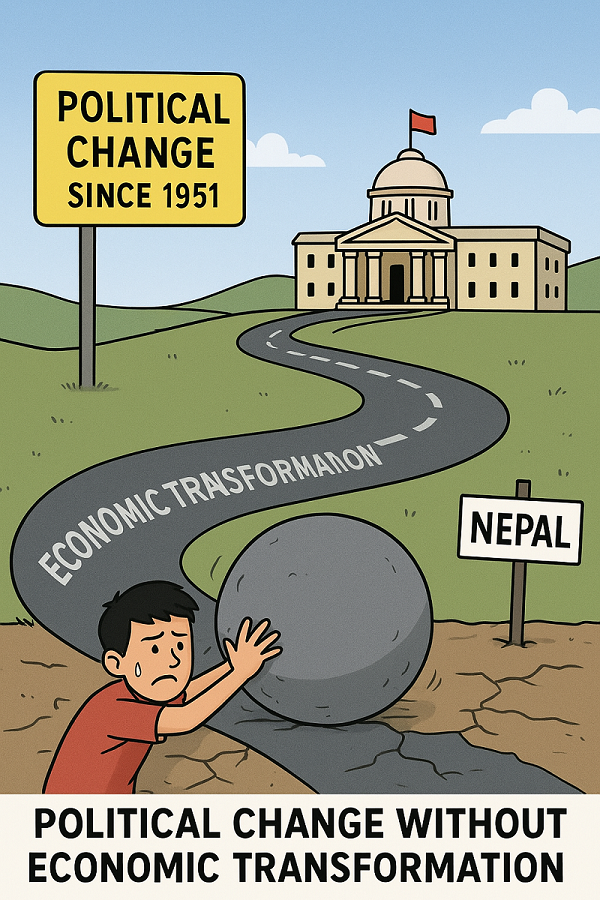
Since the political change of 1951, Nepal has experienced repeated waves of political transformation. From the end of the Rana regime to multiparty democracy, from monarchy to republicanism, and finally to federalism, the country has continuously restructured its political system. Over the past 72 years, 23 prime ministers have led numerous governments, each promising stability, prosperity, and national progress. Yet despite these political shifts, Nepal’s economic transformation has remained largely unrealized.
During this period, the state invested heavily in physical infrastructure. Roads and bridges expanded across hills and plains, connecting remote regions to urban centers. Schools, colleges, and hospitals were established in large numbers. Access to electricity, mobile communication, and the internet reached villages that were once isolated. On the surface, these developments suggest progress. However, economic strength is not measured by infrastructure alone. The fundamental indicators of development—productive employment, industrial growth, and sustainable livelihoods—remain weak.
The core problem lies in misplaced national priorities. Development was largely equated with concrete structures rather than with strengthening human capital. While infrastructure is necessary, it is not sufficient. The state failed to invest seriously in research, innovation, and entrepreneurship—sectors that drive modern economies. Universities focused more on producing degrees than on generating knowledge, research, and solutions tailored to national needs. Innovation ecosystems were not nurtured, and risk-taking entrepreneurs were left without institutional support.
Talented and capable youth, instead of being encouraged to innovate and create enterprises, faced bureaucratic barriers, policy uncertainty, and limited access to finance. Enabling laws and long-term strategies to support startups, small industries, agro-processing, and technology-based enterprises were either weak or poorly implemented. As a result, millions of young Nepalis were compelled to seek employment abroad. Today, the national economy relies heavily on remittances, which sustain consumption but do not build productive capacity or long-term resilience.
This overdependence on foreign labor markets exposes Nepal to global economic shocks and drains the country of its most energetic and creative population. While remittances help households survive, they cannot replace domestic industries, innovation, or employment generation. A nation cannot achieve prosperity by exporting its workforce indefinitely.
Infrastructure alone does not build a nation. Roads do not create jobs unless they lead to factories, farms, and enterprises. Buildings do not strengthen an economy unless they house productive activity. True development requires employment, production, innovation, and value creation within the country.
This reality demands serious reflection, especially from the younger generation. Political change without economic vision leads to stagnation. The coming elections should not be treated merely as contests for power, but as opportunities to redefine national priorities. Unless young people step forward in leadership, policy-making, and decision-making with a focus on economic transformation, Nepal’s promise of progress will remain unfulfilled. The time has come to convert political change into real economic change.
Related News