 Nepal Newsbox
2083 Jestha 16, Saturday
Nepal Newsbox
Nepal Newsbox
2083 Jestha 16, Saturday
Nepal Newsbox
DIGNITY IN POVERTY ( A Short Story)

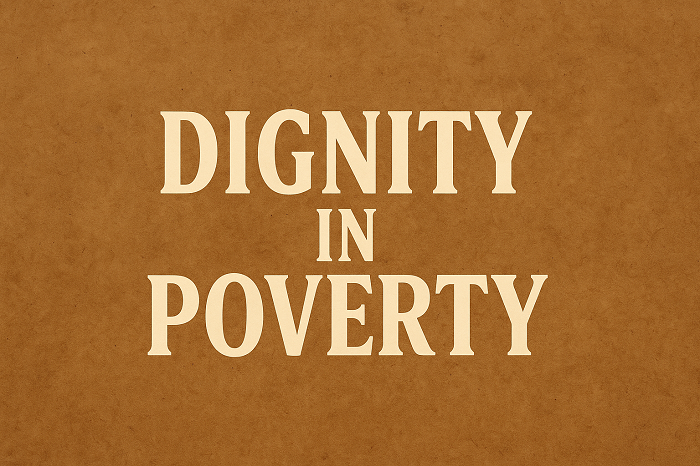
DIGNITY IN POVERTY
By
Rameshwar Yadav
The morning sun crept shyly through the slum alley of Dharavi of Mumbai, painting the tin roofs with golden hope. Smoke rose from small fires where women boiled tea in dented pots. The air was full of noise — roosters crowing, children laughing, and radios crackling with the same old songs.
Amid this symphony of survival lived Hari, a man of forty, whose pockets were often empty but whose heart was never bankrupt.
The Tailor of Dharavi
Hari was a tailor — not the kind with glass windows and mannequins, but the kind who worked under a plastic roof that flapped with every gust of wind. His sewing machine was older than his son, its iron handle polished smooth by years of faithfulness.
He lived with his wife Sita and two children — little Rupa and Manoj — in a one-room house barely large enough to hold their dreams. The walls were patched with posters of gods and heroes, and the floor gleamed each morning after Sita scrubbed it with sand and water.
They were poor, yes — but not pitiful.
Hari began each day the same way: he would light a small incense stick before his sewing machine and whisper,
“God, let my stitches hold not just cloth, but people’s confidence.”
Then he would begin his work — hemming torn trousers, stitching school uniforms, mending the fabric of other people’s lives.
People liked Hari not because he was cheap, but because he was honest. If a customer forgot money on his counter, he would chase them down the lane to return it. If someone couldn’t pay, he would smile and say, “Pay me when the harvest smiles on you.”
His hands were rough, his clothes faded, but his soul stood upright like a flag that refused to bow.
The World’s Eyes
One day, as Hari worked, a well-dressed man stopped by his shop. He was from the city — gold watch, shiny shoes, the smell of imported perfume. He looked around and said, almost mockingly,
“You still work here, Hari? In this place? You could have left for Dubai, earned real money!”
Hari smiled gently. “Yes, I could. But who would stitch Ramesh’s school shirt or mend old Ram aunty’s sari then?”
The man laughed. “That’s not success, my friend. There’s no dignity in poverty.”
Those words hung in the air like dust after a storm.
Hari didn’t reply. But something inside him stirred — a quiet pain, the kind that does not bleed but burns. That night, when everyone slept, he sat outside under the flickering streetlight.
He looked at his hands — calloused, cracked, brown with years of labor.
“They call you poor,” he whispered to them, “but you have never stolen, never cheated, never begged. You have fed my children, clothed my wife, kept my word. Is that not dignity?”
The night said nothing, but the stars blinked as if in agreement.
The Measure of Worth
Weeks passed. Business was slow. The rains came early and flooded the alley. Many of Hari’s customers couldn’t pay.
One afternoon, a wealthy lady arrived, bringing her daughter’s expensive dress. “Can you fix it quickly?” she asked, tapping her phone. “It’s urgent — a party tomorrow.”
Hari nodded, even though the fabric was delicate and his tools blunt. He worked through the night, his eyes tired but precise.
The next day, the woman returned, admired the flawless stitching, and said, “You did well. Here’s your money.”
When Hari unfolded the note, he saw she had given him double.
“Madam,” he said, running after her, “you have paid more by mistake.”
She turned, surprised. “I thought poor people liked extra money.”
Hari smiled. “We like extra respect more.”
She looked at him — really looked this time — and her proud face softened. She pressed his hand and whispered, “Then keep the respect. You’ve earned it.”
That evening, Hari walked home lighter than ever, not because of money, but because his spirit had been seen.
The Season of Scarcity
Then came winter — cruel and cold. The river dried, prices rose, and even work shrank like the daylight. Hari’s son fell sick, and medicine cost more than his weekly earning.
He thought of borrowing money, but the memory of his father’s words stopped him:
“Better empty stomach than empty honor.”
Still, hunger is persuasive.
For a moment, Hari considered selling his sewing machine. It was his only tool, his only pride. He imagined the silent mornings without its rhythmic sound — tak-tak-tak. The thought was unbearable.
So he worked instead — day and night — repairing torn blankets, patching old jackets, even making school bags out of used rice sacks.
When he was tired, he would look at his sleeping children and whisper, “Tomorrow will come. It always does.”
And it did.
The Widow and the Loaf
One evening, as Hari closed his shop, he saw Amma, an old widow from the neighborhood, struggling to lift her basket of vegetables. She was known to give half her profit away to those hungrier than her.
Hari helped her carry the basket home. She thanked him with a smile that looked older than the hills.
“I’ve sold nothing today,” she sighed. “But here, take this bread. You have children.”
Hari refused, but she insisted. “Don’t shame me, son. Giving keeps my soul warm.”
As he walked home with the bread in his hand, Hari realized something: poverty had not stolen generosity from Amma; it had purified it.
In that moment, he felt rich — not in coins, but in kinship.
The Festival of Lights
It was nearly Tihar. The city glowed with electric flowers. Shops were loud with colors, perfumes, and laughter.
In Dharavi, people made small lamps from clay and mustard oil. Hari’s children helped him make five lamps — one for each corner of their room, and one for God.
They had no sweets, no new clothes, no decorations. But when they lit the lamps, the room shone like a small universe.
Rupa said, “Baba, our lights are smaller than the city lights.”
Hari smiled, “Yes, but see how they fight the darkness anyway.”
The lamps flickered in agreement, their flames bending but never breaking.
That night, a thought bloomed in Hari’s heart —
Dignity is not the absence of darkness; it is the courage to light a lamp anyway.
The Stranger with a Camera
A month later, a journalist came to Dharavi to document “Lives Below the Poverty Line.” He carried an expensive camera and an air of pity.
He photographed people’s cracked walls, torn slippers, and bare kitchens.
When he reached Hari’s shop, he asked, “Can I take your picture?”
Hari hesitated. “Why?”
“To show the world how the poor live.”
Hari nodded slowly. “Then show them how the poor live, not just how they suffer.”
He stood tall beside his machine, hands resting proudly on the wheel. The camera clicked.
When the photo was published, the caption read:
“The Tailor Who Stitched His Dignity With Thread and Faith.”
For the first time, Hari saw his reflection not as a victim, but as a victor.
The Test of Honor
One afternoon, a merchant offered Hari a big deal — to sew uniforms for a private school. The pay was good, but the merchant whispered, “We can save money by using cheap cloth and keeping the difference. No one will know.”
Hari’s heart pounded. That much money could change everything.
He looked at the merchant and said softly, “But I will know.”
The man shrugged and walked away. Hari sat quietly, hearing the echo of his choice — painful yet pure.
That night, Sita saw him lost in thought. “You did right,” she said, “though it cost us.”
Hari nodded. “Better an empty plate than a dirty conscience.”
The next day, a teacher from the same school came looking for him. “We heard you refused the deal,” she said. “We need someone honest like you. Will you work directly for us?”
And just like that, the man who chose integrity over income found both.
The Children Learn
Years passed like seasons — harsh yet hopeful.
Rupa grew into a bright young girl, top of her class. Manoj, though shy, could fix anything mechanical.
One evening, Rupa came home from school, eyes wet. “They laughed at me because I said we have only one room,” she sobbed.
Hari wiped her tears and said, “Tell them this: in that one room live four dreams, five lamps, and a thousand honest breaths.”
She smiled faintly, understanding what words could not teach.
The Storm and the Sunrise
One year, a great storm hit Dharavi. Roofs flew, water entered houses, and Hari’s shop was nearly destroyed.
When the rain stopped, people found him outside, hammering nails, fixing what he could.
“Why don’t you wait for help?” someone asked.
Hari replied, “If I wait, I’ll lose more than a roof — I’ll lose courage.”
Slowly, the neighbors joined him. Together they rebuilt walls, shared food, and sang while working.
Out of mud and misery rose laughter and life. The storm had taken their possessions but left their pride untouched.
The Return of the Rich Man
Years later, the same well-dressed man who once mocked Hari returned to Dharavi. He had lost his business in a failed venture. His car was gone, his watch pawned, his eyes tired.
He walked through the familiar alley and saw Hari — still stitching, still smiling.
“Hari,” he said quietly, “life has turned. I have nothing left.”
Hari rose and embraced him. “Then you have space to begin again, my friend.”
The man looked around at the humble shop — the patched roof, the handmade chair, the laughter of children nearby. “You were right, Hari,” he said. “There is dignity in poverty. I couldn’t see it until now.”
Hari smiled. “It’s not in poverty itself. It’s in the way we wear it — like clean clothes even if old.”
The Quiet Victory
As years passed, Hari’s hair turned silver, but his back never bent.
He became a legend in his community — not for riches, but for righteousness.
People brought him not just clothes to mend, but stories, secrets, and sorrows. He would listen, stitch, and smile — as if sewing back the torn pieces of their lives.
His shop became a sanctuary of self-worth.
Sometimes, sitting by the door in the evening, Hari would watch children running past, chasing kites. The sunset would dip into the river, painting the sky copper.
Sita would bring him tea and ask, “Do you ever wish you had more?”
Hari would sip slowly and say, “I already have more — more peace than wealth can buy, more purpose than money can measure.”
The Legacy
Years later, when Hari passed away, the people of Dharavi carried his body through the alley he had walked all his life. Every house lit a lamp on their doorstep.
Some said, “He was poor.”
Others said, “No, he was rich — in every way that matters.”
Rupa, now a teacher, kept his old sewing machine in her classroom. She told her students,
“My father taught me that dignity isn’t something you wear; it’s something you weave — thread by thread, choice by choice.”
The Stitch of the Soul
The slum of Dharavi slowly changed — new houses, new shops, new faces. But Hari’s story lived on, whispered by mothers to their children, written on the walls of memory:
“There is dignity in poverty — when hands are honest, hearts are grateful, and hope never sleeps.”
Because poverty, like night, is only dark until someone lights a lamp.
And Hari, the tailor, had lit many.
Related News