 Nepal Newsbox
2083 Jestha 16, Saturday
Nepal Newsbox
Nepal Newsbox
2083 Jestha 16, Saturday
Nepal Newsbox
The Fear of the Leader: A Literary Analysis

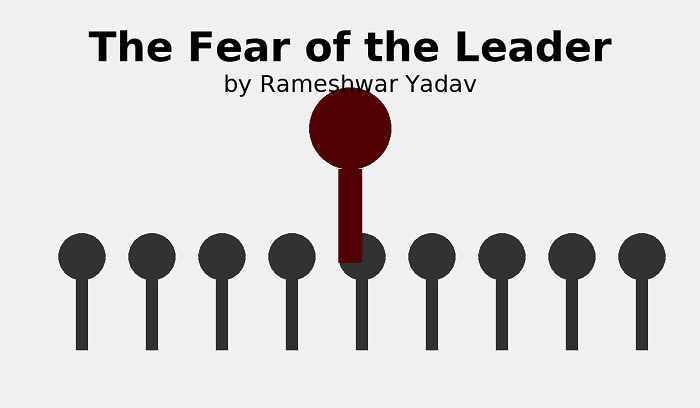
The Fear of the Leader: A Literary Analysi
By Rameshwar Yadav
Introduction
Rameshwar Yadav’s one-act drama The Fear of the Leader is a socially charged literary work that explores the paradoxical dynamics between political Leader of Nepal and People of Nepal in contemporary Nepal. Set in an ordinary tea stall and shifting into the private chambers of politicians, the play traces the awakening of collective civic consciousness. The drama is not loud; instead, its power lies in the quiet conversations, interrupted silences, and subtle shifts of tone that expose an uncomfortable truth: the real fear of leaders is not revolution, violence, or dissent, but the moment when the people begin to think, organize, and act without them.
The play’s central insight is articulated repeatedly through dialogue and narrative framing. Early in the drama, Citizen 1 and Citizen 2 understand the core of Nepal’s political disillusionment. Citizen 1 remarks, “Have you heard? The leaders never trusted the people,” and Citizen 2 responds with a laugh that masks an unspoken truth: “If they trust the people, people will start asking real questions.” These lines establish the driving tension of the narrative: the citizens are awakening, while the leaders are terrified of losing symbolic control.
This essay will explore the play’s themes of political distrust, social awakening, and leadership insecurity. It will analyze how the tea stall setting becomes a space of resistance, how satire and irony expose hypocrisy, and how collective unity becomes an instrument of revolutionary power without violence.
Theme of Trust and Distance
At the center of the play lies a tragic irony:
Leaders do not trust the people—and so, the people have stopped trusting the leaders.
The dialogue in Scene 1 humorously exposes how leadership has become a performance. The citizens joke that if leaders truly loved the people, they would see their real lives—not just their votes. This humor acts as both relief and criticism—a common feature of South Asian political satire.
The Tea Stall as a Social Mirror and Political Stage
In this drama, the tea stall is not just a backdrop; it functions as a symbolic space where public opinion is brewed alongside hot tea. In Nepal, tea stalls have long served as informal meeting grounds where people from all walks of life gather. Whether one is educated or uneducated, wealthy or struggling, everyone sits on the same wooden benches and speaks without hesitation. These spaces encourage open conversation—unfiltered, bold, and honest in ways that official political platforms seldom are.
The play opens quietly at a simple roadside tea shop. There is nothing glamorous about it: a worn-out bench, a blackened stove, steam curling from a dented kettle, and a small radio crackling with old songs under a layer of dust. The scene feels familiar to any Nepali audience, grounding the drama in everyday reality.
By choosing this setting, Yadav calls attention to where real political awareness begins. It does not start in parliamentary chambers, high-level meetings, or editorial rooms. Instead, it takes root in the places where people gather naturally—at the chauṭāri, on public steps, in village particularly at the tea stall. These are the spaces where conversation flows freely and where people examine, question, and sometimes laugh at those in power.
Thus, the tea stall becomes a mirror reflecting the true mood of society. It is also a stage where the first sparks of change appear—not through protest, but through shared understanding. The tea stall stands as a reminder that democracy lives in the voices of the people, not in the speeches of leaders.
The Narrator opens with these lines:
“In this city, tea stalls still stand on every corner,
But something else has vanished:
The people's trust in their leaders.”
The contrast between the permanence of everyday cultural spaces and the disappearing faith in governance sets the tone. The tea stall symbolizes the continuity of people’s lived realities, while political trust fluctuates, erodes, and ultimately collapses.
Citizen 2’s casual humor works as social critique. When Citizen 1 says, “They did not love the people,” Citizen 2 replies:
“If leaders loved the people,
They’d have to visit their real kitchens,
Not just their voting booths.”
This line exposes the transactional nature of electoral politics. The kitchen represents real life, real struggle, and real hunger. The voting booth symbolizes symbolic presence and temporary performance. The drama critiques leaders who appear only when they need support, not when the people need solutions.
Thus, the tea stall becomes the origin point of awakening. It is where speech is free, and fear dissolves. The act of sitting and thinking together becomes the first revolutionary gesture.
The Leaders’ Fear: Losing Control
The second scene shifts abruptly into a closed political chamber, reinforcing the divide between public authenticity and private insecurity. Leader 1’s anxiety is immediately evident:
“The people have started thinking! This is not a good sign.”
This line reveals a deep-seated belief embedded in authoritarian and populist governance alike: the governed must not think. Thinking threatens dependency. Thinking reveals alternatives. Thinking opens possibilities.
Leader 2 tries to reassure him with strategic cynicism:
“Relax. Thinking people need slogans, not truth.
We’ll give them new slogans.
Bigger ones. Louder ones.”
This reflects a common political strategy: replacing substantive reforms with emotionally charged rhetoric. The louder the speech, the smaller the sincerity. The brighter the banner, the darker the political motive.
But the facade cracks when Leader 1 whispers:
“They are solving problems by themselves. Without us.”
Here lies the real fear. The leaders do not fear protest; they fear irrelevance. The drama exposes that the foundation of political authority is not service, but dependency. When citizens act independently, the symbolic capital of leadership weakens.
This is the psychological heart of the play: leaders fear the empowerment of citizens because it dismantles the premise of leadership as indispensable.
The Journalist as Moral Mirror
The entrance of the Journalist marks the intrusion of accountability. They are “polite in tone, fierce in intention,” representing media that remains rooted in integrity rather than spectacle.
The Journalist asks directly:
“The public believes you fear the people.”
Leader 1 panics, scrambling to reassert political identity:
“We are… guardians of the nation! We are… caretakers of democracy!”
However, the line ends in a stuttered collapse:
“We are… unfinished…?”
The unfinished sentence represents the erosion of rhetorical confidence. Political language fails when confronted with truth.
Citizen 2’s offstage comment, shouted playfully:
“Serve? Or charge service fees?”
becomes a moment of bold satire. Humor becomes resistance. Mockery pierces the armor of power.
The People’s Awakening and Collective Action
The fourth and fifth scenes depict a peaceful revolution. There are no protests, no riots, no confrontations. Instead, the citizens choose unity and mutual support:
“From today, we will complain less and build more.”
This line echoes the philosophy of civic empowerment: change emerges from participation, not expectation.
The Narrator’s final declaration reinforces the shift:
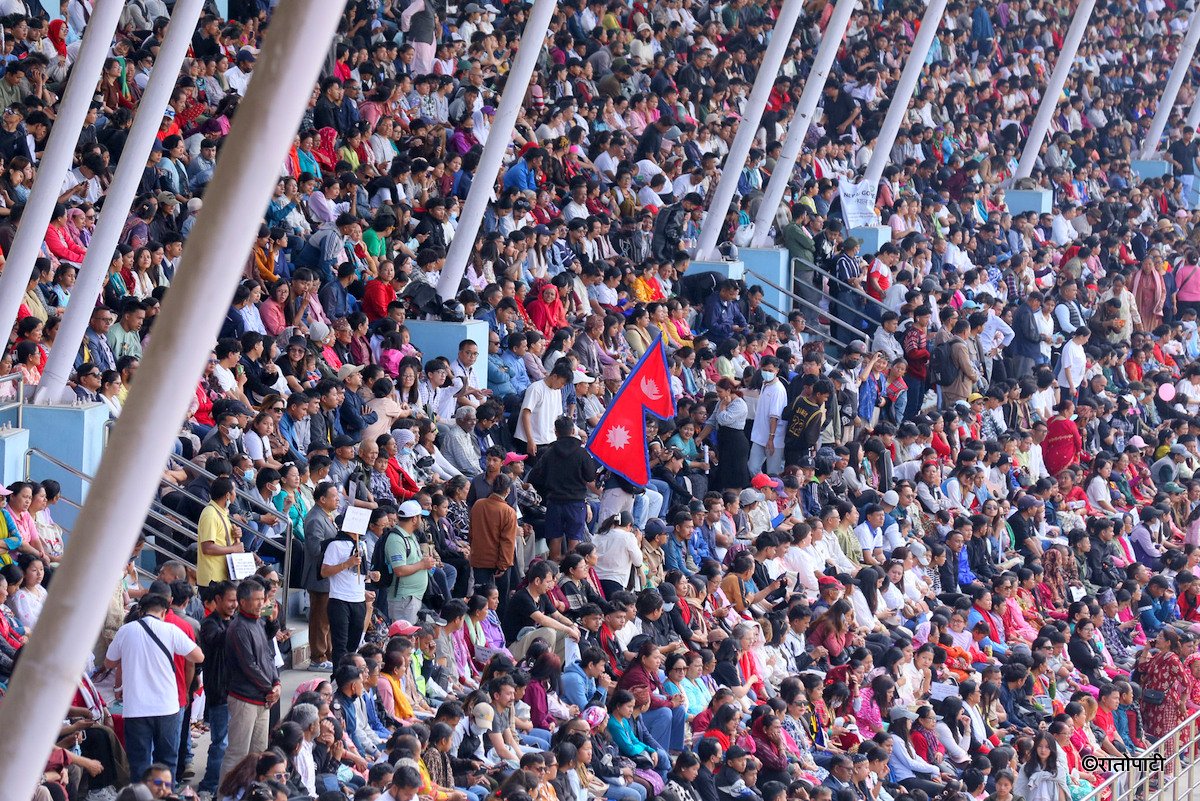
“The leaders saw crowds at last.
But no longer crowds waiting for promises.”
Crowds are no longer passive. They no longer seek saviors. They are the agents of their own transformation.
This is where the title The Fear of the Leader reaches its resolution: Leaders fear not rebellion, but emancipation from dependency.
The Leader’s Realization
The final line—
“For the first time, the leaders truly feared the people.”
—is a powerful re-centering of authority.
The fear is not physical.
It is existential.
The leaders fear:
- Accountability
- Transparency
- Collective unity
- The end of political theater
Most importantly, they fear a society that no longer looks upward for solutions.
Conclusion
Rameshwar Yadav’s The Fear of the Leader stands as a thoughtful and incisive contribution to contemporary Nepali political theatre. The play examines the uneasy relationship between leaders and the public, revealing that political authority often rests not on strength, but on the fear leaders carry within themselves: fear of accountability, fear of unity among citizens, and most of all, fear of an awakened population.
Rather than depicting grand revolutions or dramatic uprisings, the play focuses on the quiet spaces where awareness begins. The tea stall, an ordinary and familiar setting, becomes a powerful stage where political consciousness slowly brews. Through conversation, shared laughter, and shared frustration, the citizens in the play come to recognize their own agency. In doing so, the play suggests that real change does not start with laws or elections, but with understanding and collective realization.
At the same time, the play critiques populistic leadership, exposes the fragility of political authority, and elevates everyday spaces like the tea stall as sites of revolutionary dialogue. It is within these simple social spaces that the first stirrings of political awakening take root.
The message is clear and resonant:
Power does not ultimately belong to those who govern, but to those who participate.
The play does not encourage chaos, violence, or the overthrow of systems. Instead, it invites the audience to reflect, to question, and to take responsibility. It calls for citizens who are engaged rather than passive, thoughtful rather than silent.
In this way, The Fear of the Leader speaks to a timeless political truth: when people remember their strength, leadership must adapt, respond, or dissolve. The drama serves as a reminder that democracy thrives not on speeches, slogans, and promises, but on the active involvement of its people. Its quiet tone is deliberate, for the most transformative changes often begin not with noise, but with understanding.
It is a quiet play, but its quietness is purposeful. Rather than staging dramatic revolution, it stages recognition: the subtle awakening of political awareness among ordinary citizens. By using humor, simplicity, and everyday dialogue, Yadav creates a work that resonates deeply within Nepal’s present socio-political climate.
And as the curtain falls, one truth lingers:
When the people awaken, the leaders tremble.
Related News