 Nepal Newsbox
2083 Jestha 16, Saturday
Nepal Newsbox
Nepal Newsbox
2083 Jestha 16, Saturday
Nepal Newsbox
From Guns to Roses: Biplav’s Transformation and Its Meaning in Nepali Politics

**From Guns to Roses: Biplav’s Transformation and Its Meaning in Nepali Politics**
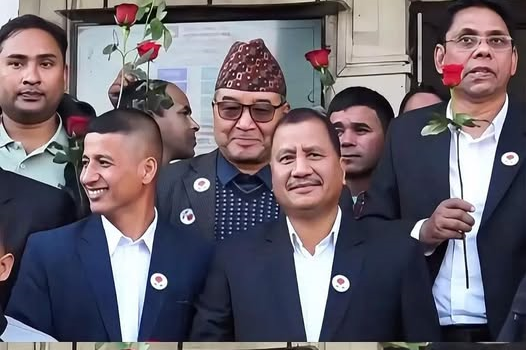
“Ah! How wonderful. The one who once fired guns is now holding a rose.” — This remark has become widely discussed in social and political circles today. Once recognized as the symbol of an underground armed struggle, Netra Bikram Chand ‘Biplav’ now appears fully committed to the path of peaceful politics by choosing a rose as the official symbol of his party.
This shift represents not just a change in political branding but a profound moment in Nepal’s political evolution, especially for a figure once synonymous with rebellion.
1. Stepping Out of the Shadow of the Gun — Biplav’s Transformation
For years, Biplav was known for his “hardline politics,” “armed resistance,” and confrontations with the state. His faction, which broke away from the Maoist mainstream, believed that the political achievements of the People’s War had been diluted and betrayed.
Under his leadership:
- Bomb blasts targeting government offices and private institutions became common.
- Forced shutdowns disrupted daily life and harmed the economy.
- Underground operations created fear among local communities.
- The state responded with heavy-handed crackdowns, leading to a cycle of retaliation.
This environment defined Biplav as a leader of resistance rather than reconciliation.
But today, the same leader is stepping into democratic politics holding a rose—choosing peace, dialogue, and electoral competition.
This is not a small leap. It signals:
- An acceptance that politics cannot survive indefinitely outside democratic structures.
- A recognition that public trust cannot grow in an environment of fear.
- A strategic understanding that influence in modern Nepal requires legitimacy, not intimidation.
The journey from the gun to the rose symbolizes both a personal political awakening and a strategic recalibration.
2. The Rose — What Does the Symbol Convey?
The rose conveys three major messages:
A) An aspiration for peace
A rose universally symbolizes love, harmony, and conflict resolution. For a leader with a militant past, choosing such a symbol reflects a deep desire to rebrand himself as a promoter of peace rather than a carrier of violence.
B) A call for coexistence and cooperation
The rose hints at the idea that Nepali politics can be gentler, cooperative, and more emotionally meaningful. It also suggests that Biplav wants to distance himself from bitterness, revenge, and ideological rigidity.
C) A shift toward emotional and symbolic politics
Modern politics is increasingly visual and symbolic. The rose appeals to youths, urban populations, and moderate voters more effectively than a militant icon would. It creates a bridge between Biplav’s past and his envisioned future.
In sum, when a former rebel chooses a flower, it represents not just a shift in party symbol but a reconstruction of political identity.
3. Why the Change? — Political Analysis
Analysts identify three major forces shaping Biplav’s transformation:
A) National and international pressure
International actors, rights organizations, and diplomatic missions have consistently criticized violent underground politics.
Similarly, the Nepali public grew tired of fear-based politics.
To remain politically relevant, Biplav had to adapt to a changing environment where violence guarantees neither influence nor legitimacy.
B) Exhaustion within the organization
Years of operating underground took a heavy toll on his cadres:
- Constant mobility
- Lack of stable income
- Risk of arrest
- Psychological stress
- Family separation
Many younger members began questioning the sustainability of an endless resistance campaign. The leadership had to respond to this internal fatigue or risk disintegration.
C) The need to secure legitimate political space
Remaining underground deprived Biplav of real influence over national policymaking.
By choosing formal politics:
- He gets a seat at the table.
- He can compete electorally.
- He can shape agendas on nationalism, governance, and social justice.
Thus, adopting the rose is also a strategic move to reclaim political space and redefine relevance.
4. Public and Party Reactions
Public response is mixed and layered:
Supportive voices say:
“Nothing is greater than human life; the peaceful path is the right path now.”
Those who suffered during conflict welcome this shift as a sign of healing.
Skeptical voices say:
“Is this just an image makeover?”
People question whether the transformation is genuine or merely a calculated political stunt.
Political parties observe the move cautiously:
Biplav’s entry into peaceful politics could shift political dynamics, especially in:
- Rural hill districts
- Madhes and marginalized regions
- Youth demographics disenchanted with mainstream parties
His presence might fragment traditional vote banks and introduce new competition.
5. Conclusion — Can a Rose Heal Old Wounds?
Biplav’s shift from carrying a gun to carrying a rose is undoubtedly a major transformation. But a mere change of symbol does not represent complete change. Real political evolution requires:
A) Honest self-reflection
Acknowledging past mistakes and the harm caused by violent methods.
B) Moral responsibility
Extending reconciliation toward victims of bomb blasts, intimidation, and disruption.
C) Democratic commitment
Proving through action—not just symbolism—that the future will be peaceful, transparent, and rooted in constitutional politics.
If the rose becomes more than a flower—if it becomes a symbol of true transformation in thought and behavior—then Nepal might gain a responsible political figure from a former rebel.
Otherwise, as the popular line goes:
“What a mistake you made, and this is the price you pay,”
Nepal’s political tomorrow may remain uncertain once again.
Related News