 Nepal Newsbox
2083 Jestha 16, Saturday
Nepal Newsbox
Nepal Newsbox
2083 Jestha 16, Saturday
Nepal Newsbox
The Measure of a Human: Hark Sampang’s Call for Equality Through Labor


The Measure of a Human: Hark Sampang’s Call for Equality Through Labor
By Rameshwar Yadav
“Man is always equal to another man.”
The sentence sounds simple—almost too simple for a world tangled in status, money, and titles. Yet its truth is ancient: a human is equal to another human simply because both are human. No certificate, no bank account, no office chair can raise one soul above another.
But in Nepal, as in many societies, equality often remains a word framed in speeches, not a reality felt on the streets. People bow to rank, not to humanity. They honor education, but not wisdom; wealth, but not work. And slowly, quietly, a wall rises between people—an invisible wall, but just as cold and divisive as stone.
Hark Sampang looks at this wall and offers not a slogan, not a political program, but a tool: the culture of labor—Śram Sanskriti.
Not as decoration, but as a practical method to make equality walk on two feet.
Where Hierarchy Ends and Humanity Begins
Imagine a group of men and women cleaning a clogged canal in Dharan. Some are farmers, some students, some shopkeepers. Among them stands the mayor himself, sleeves rolled up, feet in the same muddy water. At that moment, no one cares whose house is bigger or whose English is better. Sweat becomes the great equalizer. Labor dissolves superiority.
There is no “sir” or “madam” in the ditch. There are only hands, soil, and shared purpose.
This is the world Sampang imagines—a world where hierarchy melts in the heat of honest work. Where equality is not written on a banner but lived in the streets.
The Only Formula That Truly Works
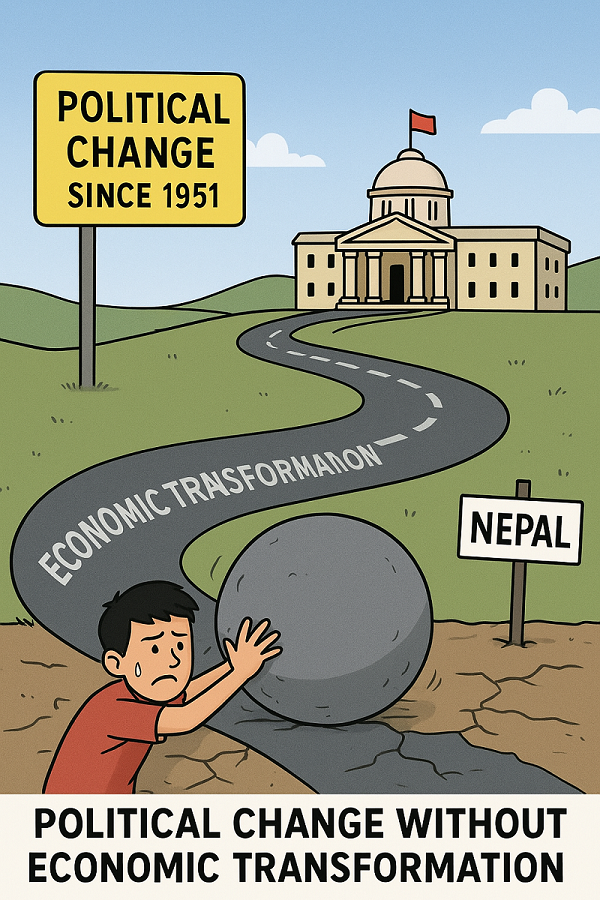
For decades, Nepal has experimented with political reforms, development models, inclusion policies, and constitutional promises. Yet social divides persist. Because inequality is not only a system—it is a culture.
And culture cannot be changed by paperwork.
It can only be changed by practice.
That is why Sampang insists that Śram Sanskriti is the one and only formula that turns moral truth into daily reality. When people of every class join in labor, they learn something schools never teach and wealth cannot buy: the dignity of effort.
- Labor humbles the elite.
- Labor strengthens the poor.
- Labor binds strangers into community.
- Labor breaks pride without breaking spirit.
It is work—not speeches—that humanizes us.
The Human Story Beneath the Idea
Think of a child born in the most expensive hospital in Kathmandu, and another born in a small rural cottage under a tin roof. The first may be wrapped in soft blankets, the second in a shawl. But both open their eyes to the same world, breathe the same first gasp of air, and cry the same cry.
Nature makes no distinction.
Society builds all the distinctions later.
A degree may make someone knowledgeable, but not superior.
A house may make someone comfortable, but not more valuable.
A position may give authority, but not greater humanity.
Deep inside, the wealthy man and the poor man, the scholar and the illiterate, the mayor and the sweeper—share the same fears, same hopes, same hunger, same mortality.
Equality does not need to be created. It only needs to be recognized.
Where This Idea Meets the Ground
If Nepal truly wishes to turn Sampang’s philosophy into reality, it must begin where people live, not where laws are printed.
Practical steps include:
1. Community Labor Days
Every month, citizens and government officials work together—cleaning rivers, repairing roads, planting trees. When leaders pick up tools, trust is built.
2. Labor Education in Schools
Students should learn not only mathematics but also how to plant, repair, clean, build—skills that teach humility and self-reliance.
3. Public Respect for Workers
Society should honor the farmer who feeds a nation, the sweeper who keeps cities clean, the mason who builds our homes. Real heroes wear dust, not medals.
4. Leadership by Example
Any leader who refuses to participate in community labor reveals their distance from the people they claim to serve.
This is not a utopian dream—it is a cultural shift that begins with small, stubborn acts.
A Literary Truth, A Practical Path
Equality is not a decoration for speeches. It is a lifelong discipline. A habit of seeing every person as a reflection of oneself. A willingness to bend, to lift, to sweat for the common good.
Hark Sampang’s message is both poetic and practical:
Humans are equal by birth, but labor makes that equality visible.
In the mud, on the road, beside the river, under the sun—we rediscover that we are the same kind of beings, bound by the same earth.
Conclusion: The Hands That Build Equality
One day, if Nepal truly embraces Śram Sanskriti, people will look at each other differently. Not as “thulo manche” or “sano manche,” not as educated or uneducated, not as rich or poor—but simply as humans sharing the same land, the same labor, and the same destiny.
Equality will no longer be a theory.
It will be a practice.
A culture.
A daily act of remembering who we truly are.
Because in the end, a human does not become great by rising above others.
A human becomes great by standing with others, shoulder to shoulder, hands in the soil of a shared future.
Related News